B2B and SaaS Customer Support: Best Practices for 2026

On this page
- What B2B customer service is
- How B2B support differs from consumer support
- What SaaS technical support covers
- How to structure a B2B support team
- B2B customer service best practices
- B2B customer service examples
- Metrics to track in B2B support
- Where B2B support is heading
- How to choose a SaaS helpdesk
- Frequently asked questions
- About Productlane
I'm Raphael, co-founder of Productlane. Since 2021, hundreds of software companies have run more than 800,000 support conversations through our tool. This guide covers what B2B customer service is, how it differs from consumer support, and what the best support teams we work with do. Along the way I share numbers from our own support inbox. I also researched the topic and link to the sources, in case you want to read more.
What B2B customer service is
B2B customer service is the support a company gives to customers that are businesses themselves. Your customer is an account: a company with an admin, a buyer, a few dozen users and usually a contract. Every conversation belongs to that account, even when one person writes it.
SaaS customer support is the version of B2B service that most software companies run. The product is the service, so most questions are about the product. Customers ask how a feature works, why a result looks wrong, or whether the product can do something their team needs.
Bain & Company, the management consultancy, studied what business buyers value and published the result in Harvard Business Review. They found 40 kinds of value, from price and product quality to how easy a vendor is to work with. The finding that matters for support:
"With 40 distinct kinds of value, B2B managers can identify what matters most to each set of important stakeholders."
In support terms, the people on one account judge you on different things. The admin wants a correct answer about permissions. The end user wants to finish a task today. The buyer wants proof at renewal that the contract was worth it.
So a B2B support team answers to the whole account, beyond the person who wrote in. Your support tool should group conversations by company and show everything that account asked before.
How B2B support differs from consumer support
Consumer support usually handles high volume. Many customers ask similar, simple questions, and each one carries little revenue. B2B support has fewer customers, harder questions and more revenue behind each answer.
Several people per account
Gartner, a research firm that surveys businesses and advises executives in about 90 countries, found that B2B buying groups now range from five to 16 people across up to four functions. Many of them write to support after the sale. When three users from one company report problems in the same week, someone on your team should see the pattern.
Customers expect you to know them
In a separate Gartner survey of more than 5,800 customers, 86% of B2B customers expected a company to be well informed about them during a service interaction. For consumers, the figure was 71%.
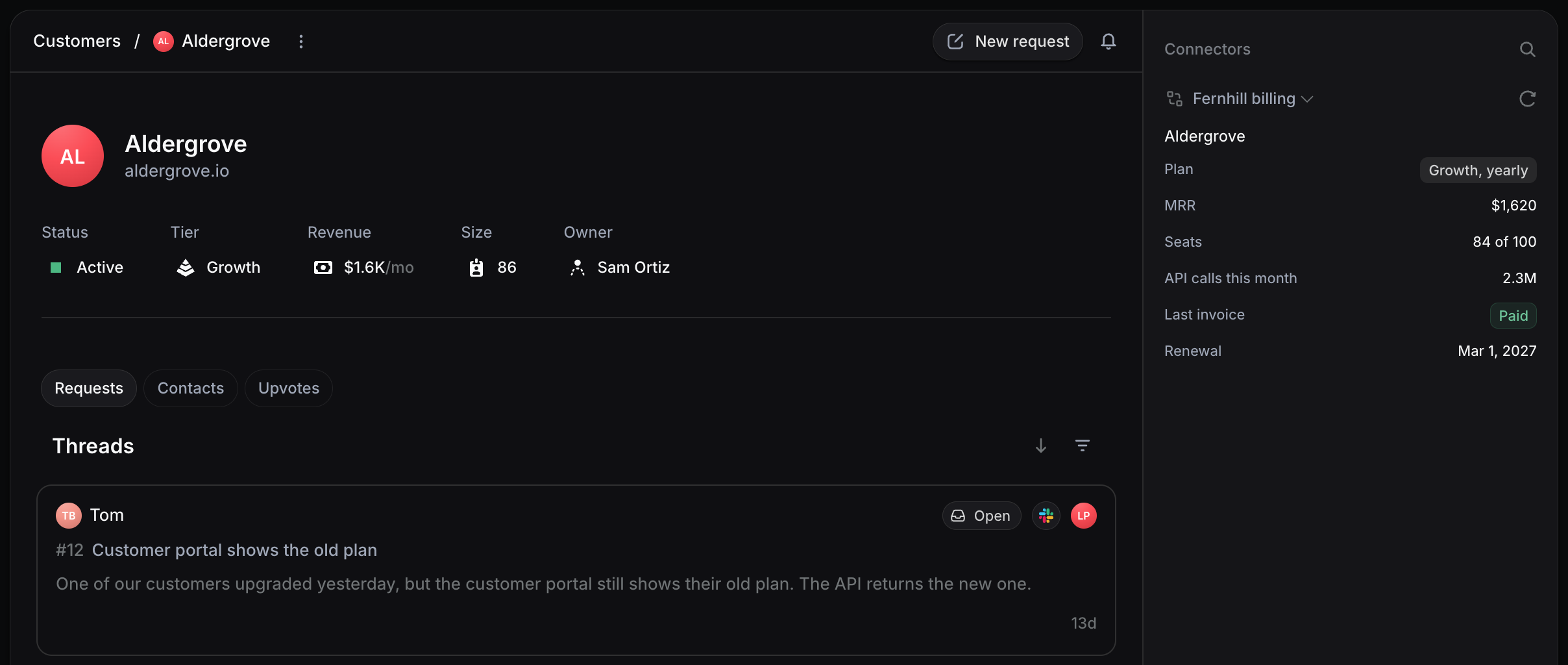
This changes what your support tool has to do. Whoever answers, a person or an AI agent, needs the account's plan, setup and recent history next to the message. Much of that lives in your own product database, outside the support tool. The good setups read it live, so nobody has to ask the customer for their workspace ID.
Contracts and response times
Larger customers write response times into their contract. Those service level agreements turn speed into an obligation, and consumer brands keep raising the bar. McKinsey, the management consultancy, found that B2C companies typically score 65 to 85% on customer experience, while B2B companies average below 50%. In their words, consumer expectations of speed "are migrating to B2B."
I haven't found solid research that measures how much a slow reply raises B2B churn, so be careful with precise numbers you see online. The direction is clear, though. As Jeffrey Schott of Gartner put it, customers "will leave or stop purchasing from a company because of service failures." A reply that comes days late is one of those failures.
More revenue per account
One lost B2B account can cost as much as hundreds of lost consumers. A customer's support history comes up in the renewal conversation. The team that answers questions also hears about risk first, from a frustrated admin to a feature gap a competitor fills.
What SaaS technical support covers
SaaS technical support is the part of customer support that deals with how the software works. To see what that means in practice, we sorted the 300 most recent conversations customers started in our own support inbox, from September 24 to October 24, 2026. We left out spam, sales pitches and internal tests, then counted each conversation once, by its main ask:
- How-to questions23%How do I import our existing help center articles?
- Bugs17%Our portal shows a rate-limit error after a few visits
- Integrations and API17%Our Linear issues aren't showing up in requests
- Account and billing15%Our invoices are missing VAT
- Configuration12%Can we make our docs visible only to logged-in users?
- Feature requests11%Can we target announcements at specific user segments?
- Other5%Security reviews, roadmap questions, general feedback
Bugs and feature requests made up 28% of the sample. The other 72% were questions about using, setting up or paying for the product. Those need product knowledge more than engineering time. Our customers are software teams themselves, so your mix will look different. About half of our account and billing requests were cancellations, for example.
The same 300 conversations also show where customers reach us. Most came through chat, because our own widget and AI chat sit inside the product. Slack Connect came next. Your mix will depend on where you put the entry points, so offer support where your customers already work.
- Chat widget and AI chat77%
- Slack Connect15%
- Email4%
- API and forms3%
- Portal1%
Bugs and feature requests leave support
Both need a ticket in the tool engineering works in, with the customer linked to it. In our sample, 82% of bugs and feature requests were linked to a Linear issue. That link is what lets someone tell the customer when the fix or the feature ships.
Paul Graham, co-founder of the startup accelerator Y Combinator, calls this contact with users a necessary part of the feedback loop that makes the product good.
Coding agents shorten the path to a fix
SWE-bench, a benchmark researchers built from real GitHub issues, tests whether an AI model can write a working fix. When the paper came out in 2023, the best model solved 1.96% of the issues. On the official leaderboard for SWE-bench Verified, a human-checked subset, the top entry now solves 76.8%. OpenAI has since warned that this subset has leaked into training data. On the harder SWE-bench Pro, the leader is at 61.5%.
Coding agents now work from the issue itself. With GitHub's Copilot coding agent, you assign an issue to Copilot and it opens a draft pull request. An engineer still reviews the change. METR, a research nonprofit, found that experienced developers took 19% longer with AI tools in a 2025 trial, so the gains depend on the task. For a small bug with clear steps to reproduce it, a coding agent can prepare a fix for review the same day.
Productlane turns a bug report into a Linear issue with the customer attached. With Cursor connected, a coding agent can start on it from the thread. When the issue ships, the agent replies to everyone who reported it.
See the loop from customer to codeHow to structure a B2B support team
Most B2B software companies run support in tiers. Atlassian, the company behind Jira, describes the common model in its guide to support levels. Each tier handles what it can and passes the rest up, together with the context it gathered.
- Tier 0, self-service35% of our questionsHelp center, in-product guidance and an AI agent
Answers how-to and configuration questions before a person reads them.
Passes up: the question, the account and the answers already tried - Tier 1, frontline support15% of our questionsSupport generalists
Handle account changes, billing and triage. They decide what goes up.
Passes up: a summary, the account and what the customer already did - Tier 2, technical support17% of our questionsSupport engineers
Read logs, reproduce issues, and debug integrations or API errors.
Passes up: steps to reproduce, logs and every affected account - Tier 3, engineering28% of our questionsThe product team
Fixes bugs and builds missing features in the issue tracker. When the fix ships, support tells the customer.
Strict tiers have a cost for complex products, because each handoff adds a wait for the customer. The Consortium for Service Innovation, a nonprofit group of support organizations that created the Knowledge-Centered Service method, argues that traditional tiers can't keep up with knowledge-heavy work. Its alternative, called Intelligent Swarming, sends a question directly to whoever can solve it.
Small teams merge the tiers. At a ten-person startup, one support person often covers tiers one and two, with the founders as tier three. Writing the tiers down still helps, because it defines when a conversation moves and what it carries with it.
B2B customer service best practices
These eight practices are the ones I recommend most to B2B support teams. Most of them keep context attached to the conversation as it moves.
1. Answer from the product
The correct answer to a SaaS question depends on how the product works. Help articles describe the common path. The code defines every path. Give your team, and any AI agent you use, product knowledge deep enough to explain an edge case.
For example, an admin asks why a custom role can view a report but can't export it. The answer names the separate export permission and links to the role settings. The admin turns on that one setting and keeps the role's other limits in place.
2. Make every answer low effort
Matt Dixon led a study of more than 125,000 customers at CEB, a research firm that is now part of Gartner. Customers with a high-effort service experience were far more likely to turn disloyal: 96%, against 9% after a low-effort one. His Harvard Business Review article with Karen Freeman and Nicholas Toman sums it up: customers want a simple, quick solution to their problem.
For example, a customer asks how to rotate an API key. A low-effort reply gives the three steps and the link to the settings page. It also says how long the old key keeps working, which answers the next question before they ask it.
3. Set SLAs per plan and severity
Agree on first response targets for each plan and each severity, then look at how large vendors publish theirs. Atlassian promises a first response to a critical cloud issue within 2 business hours on Standard and 30 minutes on Enterprise. GitHub Premium Support answers urgent tickets within 30 minutes. Write your targets into your support tool so the queue sorts by deadline.
For example, a payroll software company promises enterprise accounts a first reply within one hour when a payroll run is blocked. A failed export from such an account moves ahead of routine setup questions.
4. Keep account context on every message
Show the company, plan, contract value and open issues next to each message. An agent who sees the third bug report from the same account this week can mention the earlier reports and raise the priority. So can an agent who sees a renewal next month.
The Productlane agent reads live account data from your own API or MCP server. You give it a read-only connection and decide which columns it may see.
See how the agent checks accountsFor example, a support engineer opens a ticket about a seat limit and sees that the account bought more seats yesterday. The engineer checks the billing sync instead of sending upgrade instructions.
5. Write the help center from real questions
The questions customers ask show you the gaps in your docs. The Knowledge-Centered Service method builds on this idea:
"We want to reuse what we know and capture the things that are new."
Self-service often fails at exactly this point. In a Gartner survey of 5,728 customers, the most common reason self-service failed was that customers couldn't find content relevant to their issue, in 43% of cases.
For example, a support lead finds several solved conversations about webhook signature checks. They turn the tested steps into a help article with a sample request. The next admin checks their webhook with that article before writing in.
6. Send bugs to engineering with the customer attached
When a conversation turns out to be a bug, file it in the tool your engineers already use. Link the issue to the conversation and the account. Engineering then sees how many customers hit the bug and how much revenue sits behind it.
Collect the details engineers need before you file. Researchers at Saarland University and the University of Calgary asked developers and users of Apache, Eclipse and Mozilla what makes a good bug report. In 466 responses, they found "an information mismatch between what developers need and what users supply." Developers most wanted steps to reproduce, stack traces and test cases. Users found exactly those hardest to provide. Support sits between the two, so ask the customer for the steps while the conversation is still open.
For example, a support engineer traces a calendar sync failure to a date parsing bug. They file an issue with the failed request, the linked conversations and the affected accounts. The engineer who picks it up can reproduce the error without asking each admin for the same details.
Then let engineers answer where they already work. Atlassian surveyed 3,500 developers and managers for its 2025 developer experience report. Developers spent only 16% of their time coding, and half lost more than 10 hours a week to friction. Collaboration with other teams had moved up the list of causes. In a lab study at the University of California, Irvine, Gloria Mark and her colleagues found that people make up for interruptions by working faster. The price is more stress and frustration.
So bring the customer to the engineer. When a question reaches engineering, the conversation should appear on the issue. The engineer's reply should go back to the customer on the channel they wrote in.
Each conversation becomes a synced comment on its Linear issue. A reply there goes back to the customer in Slack, email, Teams or live chat.
See how engineers reply from Linear7. Tell the customer when it ships
Rob Markey, a partner at Bain & Company, calls this the "outer loop" of customer feedback. Once a fix is approved, his advice is to let the people who initially raised the issue know what the resolution was.
Gartner found that proactive messages raise how much value customers see in a product. It also found that 82% of B2B customers contact the company after such a message. So write it to answer the obvious follow-up: what changed, and what the customer should do now.
In our own inbox, 70 conversations in the sample were linked to an issue that shipped. 65 of them got a message after the fix went live. Our automatic follow-up sent 51 of those within a minute. When a teammate wrote the message instead, the median wait was about an hour.
For example, an admin reports that CSV exports leave out a custom field. When the fix ships, support replies with the release date and asks the admin to run the export again.
8. Review key accounts before renewal
Look at support volume per account each month. A sudden rise in tickets, a run of bugs, or a quiet admin who used to write weekly are all early signs. Share them with whoever owns the account.
For example, an account manager reads a customer's support history two months before renewal. They see repeated SSO failures across several teams. They set up a configuration review with the customer's admin, and a support engineer fixes the shared setup.
B2B customer service examples
The practices above can sound abstract, so I looked for companies that have written publicly about how they run support. These four show what the practices look like inside a real team, in their own words.
Linear: engineers on a weekly rotation
Practices 6 and 7
Linear, the issue tracking company, published how its customer experience team works. The CX team triages every request. Bugs go to a "goalie", a role that rotates each week:
"Engineers and product team members rotate through the role each week"
When an issue is marked Done, an update goes back to the conversation it came from. The team then confirms the fix with the customer.
37signals: everyone on support
Team structure and practice 6
37signals, the company behind Basecamp, ran a program called Everyone on Support. For one day a month, every designer and programmer answered customer emails, so everyone in the company talked with customers on a regular basis.
Kayak: engineers who fix the cause
Practice 6
Paul English, co-founder of the travel search site Kayak, put engineers on support. As English told Inc., quoted by 37signals, after the second or third identical question, engineers would stop what they were doing and fix the code.
An IT services provider: fewer incidents, a renewed contract
Practice 8
McKinsey describes an IT services provider whose client threatened to switch providers over a steady stream of small incidents. The provider cut incidents by 45%. One client named that as its reason to renew and expand the contract.
Metrics to track in B2B support
Most support metrics have a clear origin. Use the standard definitions, so your numbers stay comparable over time and with other teams.
The time between a new ticket and the first public reply. Track it against your SLA, per plan and severity.
The average time to resolve a request, measured from the first message.
The share of requests resolved during the first contact, with no back and forth.
A short survey after each solved conversation. Read it per account as well as overall.
How easy it was for the customer to get the problem solved.
How likely a customer is to recommend you, from 0 to 10. In B2B, ask it per account at least once a year.
The share of conversations an AI agent resolves with no human reply. Count only the ones that stay solved.
How often a solved conversation comes back. A high rate means answers were wrong or incomplete.
We recommend the last two for teams with an AI agent. There is no neutral standard for them yet, and vendors count a resolution in different ways. We use the definition from Gartner's self-service research: a resolution counts only when it fully solves the issue. In practice, that means the customer stays solved and doesn't write back about the same problem.
Measure resolution from the customer's side. In Dixon's CEB data, companies believed 76.7% of issues were resolved in one contact. Their customers put it at 40%.
Where B2B support is heading
Business customers want to help themselves. In a 2026 Gartner survey of 646 B2B buyers, 67% said they prefer a rep-free experience. That survey is about buying, but it shows how business customers like to work.
Self-service was the weak spot. In a survey from December 2023, published in 2024, Gartner found that customers fully resolved only 14% of their service issues through self-service. Even for issues customers called very simple, the rate was 36%. That survey predates most of today's AI agents. AI agent vendors now report far higher resolution rates for their own customers, though each counts a resolution differently. The questions that stay open are often bugs or missing features. Coding agents are starting to shrink that share too.
AI already handles a growing share of the work. In Salesforce's 2025 State of Service report, 6,500 service professionals estimated that AI takes on 30% of their cases today. They expect 50% by 2027. Reps who use AI spend 20% less time on routine cases.
Put together, the job of B2B support is shifting. Customers want an accurate answer to their specific question, on their own, right away. When the answer is a fix or a feature, they want to hear back when it ships. Support tools that serve this well combine knowledge of the product, live account data and a link to the engineering work.
How to choose a SaaS helpdesk
A SaaS helpdesk is the software your support team works in: the inbox, the help center, the AI agent and the reports. Given where support is heading, check these six things in a trial with your own conversations:
| What to check | How to test it in a trial |
|---|---|
| Product knowledge | Ask 20 real questions from last month, edge cases included. Count the correct answers and the handoffs. |
| Account context | Open a conversation from a large account. Check that plan, history and data from your own systems show up next to it. |
| Speed | Set an SLA for one plan. Check that the queue sorts by deadline and warns before a breach. |
| Engineering | Report a test bug. Check that it reaches your issue tracker with the customer linked. |
| Follow-up | Close that issue. Check that the customer gets an automatic follow-up. |
| Data | Ask where customer data is hosted and whether it trains models. Get the answer in writing, in the data processing agreement. |
For a side-by-side look at tools, see our comparison of ticketing systems. Smaller teams can start with the best customer support tools for small teams.
Should you build your own AI agent?
Founders ask me this a lot, and it's a fair question. The model APIs are good, and a first prototype that answers from your docs takes a few days. You can build it. For some teams it makes sense, for example when support is part of the product you sell.
The real work starts after the prototype. The agent has to recognize when it's unsure and hand off to a person. It needs live account data with the right permissions. Someone has to keep its knowledge current as the product changes, test it on real conversations, and connect every channel your customers use. It also has to file bugs and follow up when they ship.
Before you decide, list those parts and ask who will maintain them a year from now. If that's an engineering investment you want to make, build. If you'd rather keep your engineers focused on your product, buy.
Frequently asked questions
B2B customer service supports businesses, so each customer is an account with several users, a contract and often an SLA. The questions tend to be technical and specific to one setup. B2C customer service supports individual consumers, with more volume and simpler questions.
SaaS technical support handles questions about how software works: how-to questions, configuration, integrations, API errors and bugs. Support teams answer most of them. Bugs and feature requests go to the product team through the issue tracker.
It depends on the plan and the severity. Atlassian promises a first response within 2 business hours for a critical issue on its Standard cloud plan, and within 30 minutes on Enterprise. GitHub Premium Support answers urgent tickets within 30 minutes. Write your targets down as SLAs and track them per account.
A common model has four. Tier 0 is self-service: the help center and an AI agent. Tier 1 is frontline support, tier 2 is technical support, and tier 3 is engineering. Each tier passes what it can't solve to the next one, together with the context it gathered.
Yes, when it has enough product knowledge. An agent that only reads help articles can answer the common path. An agent that learns from your codebase can explain edge cases in settings, permissions and integrations. Measure it on your own conversations and count only resolutions that stay solved.
About Productlane
Productlane is the customer support tool we build for B2B software companies. It covers the checklist above in three ways.
The agent learns your product from your GitHub repo. It answers the detailed questions about settings, permissions and integrations that a docs-only agent hands to your team. It replies only when it is confident.
A connector reads live data from your own API or MCP server, so the agent sees the plan, the setup and the history behind each message.
What the agent can't answer becomes an issue for your engineering team, with the customer attached. When the fix ships, every customer who asked gets a follow-up. Customer data stays on AWS in Frankfurt.
See how the AI agent works, or check pricing for your ticket volume.
Perfect autonomous user experiences.
- Autonomous AI support for software companies
- Product knowledge from your connected codebase
- An inbox for the conversations that need your team